|
The Restoration Project
|
The Meetinghouse Restoration Project
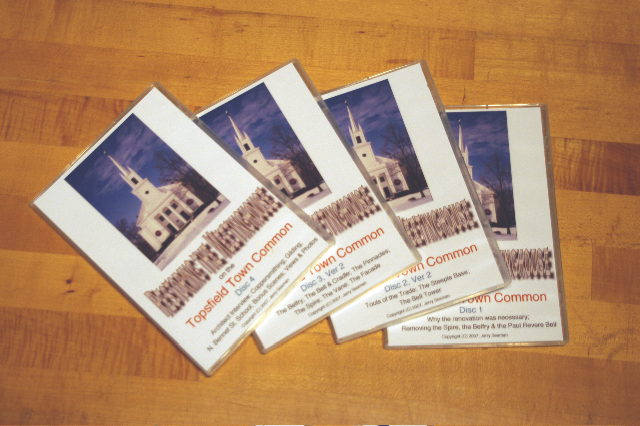
A set of 4 DVDs covering the Restoration of the Topsfield Meetinghouse are now completed and published and available. The DVDs will be sold for $15 each, $10 of which will be donated to the Aspire Campaign.
Please contact Jerry Seaman (jerry58 "at" mac.com) for your copy or download the Order Form in PDF format.
The term Meetinghouse for the Church building comes from the earliest settlement of the town. The Town Meeting form of government has its origins with our Puritan forebears in the Congregational Church, the center of the earliest New England settlements. In those early days it was not possible to separate the governance of the Town from the governance of the Church because Church and Town were one and the same. The Meetinghouse was both the place of worship and the place of conducting the business of the community. As a reminder of this, we still call our Church building the Meetinghouse. Records of the earliest “Town Meetings” are devoted to such matters as the cost of building a pulpit, orders to the selectmen to repair the Meetinghouse, and a matter of great contention – how to organize the seating arrangements for the people of the community in the Meetinghouse. Committees were appointed to make recommendations and implement many of the votes of these Town Meetings. Until 1823, the minister was chosen in open Town Meeting, and his salary was paid by a “tax” levied on all of the residents of the Town. The history of this church can be traced to the first “minister of the gospel” who preached to the New Meadows settlement in 1641. Parson Joseph Capen led the community from 1682 until 1725, and it took three years to find a suitable replacement, the Reverend John Emerson, who held the position for forty-six years. The first Meetinghouse was located near Howlett Street and Meetinghouse Lane. The second Meeting House was built in what is now Pine Grove Cemetery because the settlers in Rowley Village (now Boxford) agreed to share in the expense of a minister if the meeting house was closer to their settlement. When that building became too small, the third Meetinghouse was erected on the location of today’s building. Each of these decisions occupied Town Meeting for some years. Over time the Church and the Town developed separate identities and, of course, budget, but the building, itself, is still called the Meetinghouse.
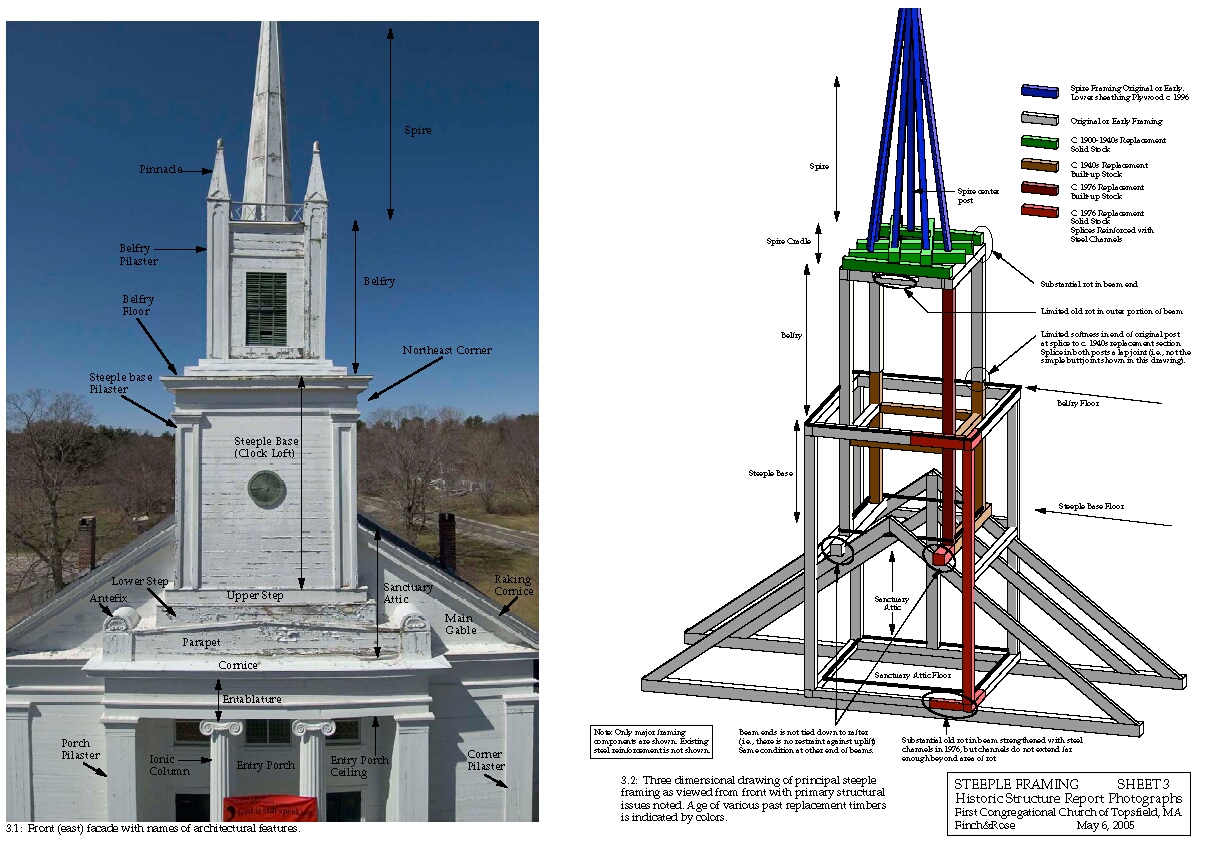
The overall Meetinghouse project will address structural issues identified in the attic, tower, belfry and spire as well exterior sheathing issues on the main façade and steeple including rot and missing or damaged decorative elements. One component of this project is the removal, restoration and reinstallation of the spire. As testimony to the craftsmanship of the builder of the Meetinghouse, the spire survived intact for over a hundred years before it needed repair. For the past fifty years, repairs using steel supports and “band-aid” efforts have led to further deterioration. This project will undo the ill-conceived repairs of the past and rebuild the structural elements of the steeple in keeping with their original materials and design. It is the goal of this project to restore the original structural integrity of the spire and thereby give it a long-lasting future life. During the course of the restoration project, the Paul Revere bell and its original cradle will be removed and any necessary repairs will be made. After extensive research, the Church determined that the best approach from both the historical and economic points of view is to restore the Meetinghouse to its structural integrity using the methods and materials with which it was built originally. Arron Sturgis of Preservation Timber Framing has been engaged to undertake this project. Well known in Topsfield, indeed in the wider world of historic preservation, Mr. Sturgis and his team will remove the steeple, belfry and bell and reconstruct them on the front lawn of the Meetinghouse. Work will begin at the beginning of July, 2006 and should be completed sometime in October, 2006. This time promises to be exciting for Topsfield. A huge crane will be removing and replacing the structural elements. The Revere bell will be visible to the community for the first time since 1842. People will be able to watch the process whereby Preservation Timber Framers utilizes traditional timber framing techniques to rebuilt the structure. The Church anticipates arranging a number of educational events during this time, including the opportunity for Proctor School children to visit the site and possibly inclusion in the Essex National Heritage “Behind Closed Doors” program. This will be a wonderful opportunity for the Church to share its historic structure with the wider community.
Assessment
The preservation firm of Finch & Rose has completed the assessments with engineering assistance from Ocmulgee Associates. One of the goals of the Conditions Assessment was to identify original and important building fabric. The main issues of the Meetinghouse are focused in framing members of the attic, tower, belfry and spire and exterior elements of the building as a whole.
 |
 |
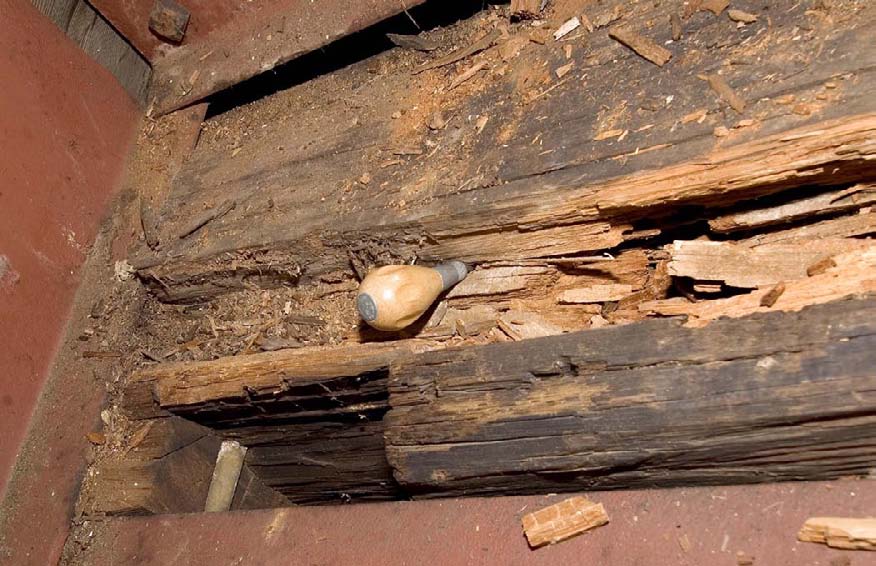 |
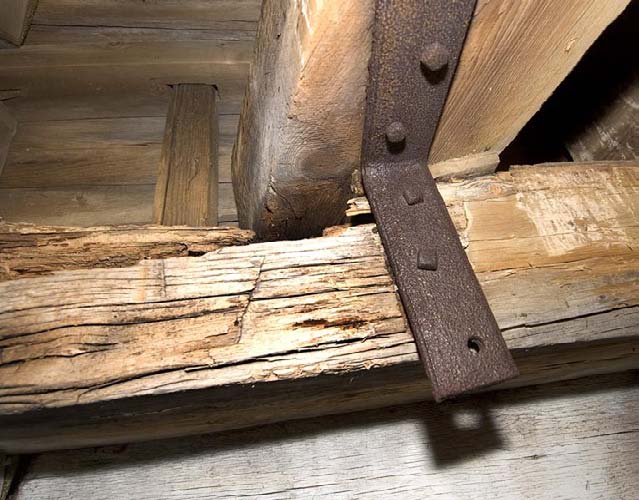
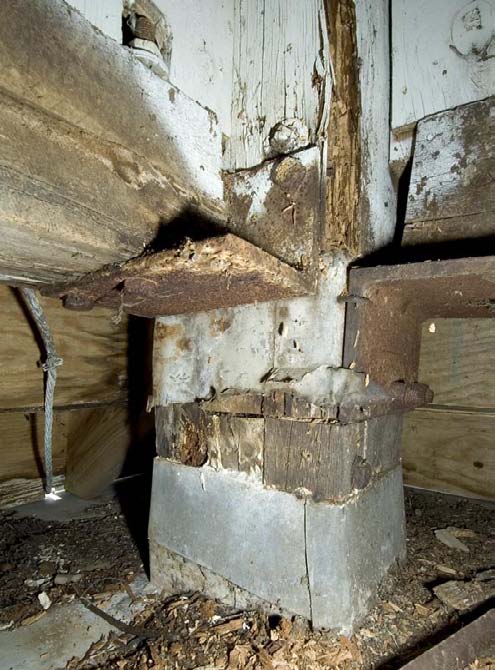
Water infiltration has led to rot and paint deterioration of the steeple
and the main facade. More specifically there has been discovery of rotted
beams in the base of the tower, lack of positive connections between the
tower posts and roof trusses, poor drainage conditions at the floor of
the belfry, rotted timbers in the belfry roof and floor, over-stressed
members in the roof truss that supports the tower posts and defects in
the joists supporting the plaster ceiling in the nave. The belfry and
spire tilt toward the north caused by rot in the southeast corner of the
tower and belfry framing. The main façade pediment and portico have suffered
from water infiltration and rot in places and require intensive refurbishment.
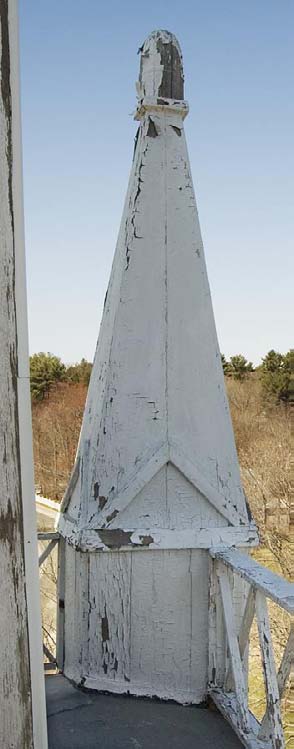
The top 1/3rd
of the spire sheathing appears to be original or early flush board with
the bottom 2/3rd
replaced with plywood. While aiding
in the rigidity of the spire, the paint is failing miserably and the appearance
is not historically accurate. In need of restoration are original decorative
elements on the exterior of the belfry including a gothic balustrade,
ballflowers, and four small spires. The entire exterior of the building also needs to be intensively
scraped or have the paint removed and then repainted.
Historic background
Over thirty years ago the citizens
of Topsfield voted to establish the Topsfield Common Historic District
in order to protect what is widely known as one of the best preserved
rural town centers in New England. The
District was recognized in 1976 as a National Register Historic District
because of its importance to our Nation’s history. Set up as a military
training field in the mid-17th century, it was used by the militia in
early Colonial times. Local Minutemen gathered here before departing for
Concord and Lexington and later Bunker Hill. The Common is ringed by buildings
representing each of the great periods of American architectural history
from Colonial times through the 20th century beginning in 1703 when a
meetinghouse was constructed on the West side. In 1759 this was replaced
by a second meetinghouse, and ultimately by the present building in 1842.
Other important buildings along with beautiful colonial residences include
the Parson Capen House, the Commons – once the Methodist Church - the
Emerson Center, Town Hall, Proctor School, the Town Library and the Meetinghouse.
While the Church’s two buildings are significant historic buildings for
Topsfield, the Meetinghouse has important connections elsewhere in Essex
County. Mark Richards Jewett, a master builder from
Ipswich and Rowley constructed the Greek Revival Meetinghouse in 1842. During
the investigation his name was discovered on a rafter and further research
has determined that he is responsible for construction of meetinghouses
in Rowley, West Boxford, Hamilton and Wenham and possibly other Essex
County congregational churches. The
church’s preservation project will yield information relative to the evolution
of this prolific architect/builder’s craft and the building industry in
early 19th century Essex County.
 |
 |
 |
As a community, we treasure the historic buildings surrounding the Common.
They create a sense of place that is uniquely ours. Integral
to the character of the village, and symbols of Topsfield’s historic memory,
they give us a direct and meaningful link to our past. We have an obligation to preserve them for future generations. The
Town of Topsfield has shouldered this responsibility with recent renovations
of the Town Library, Proctor School and the exterior of Town Hall. The Historical Society maintains the Parson
Capen House and the Gould Barn in excellent condition. Now the Congregational Church has assumed
its commitment to repairing the 1842 Meeting House, the building that
symbolizes Topsfield’s Common and its companion building the 1814 Emerson
Center (the Church’s offices and fellowship center).
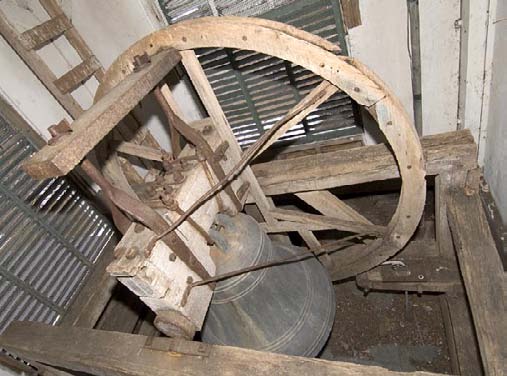
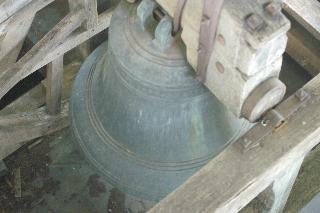
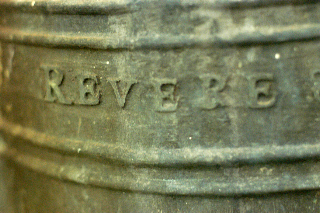
Hidden from public view since 1842 is one of the surviving bells crafted
in the foundry of Paul Revere and his sons. The
Topsfield bell is listed in the Revere
Company stock books as having been manufactured in 1817, was sold
to the Congregational Church of Topsfield and weighs 938 lbs. Paul Revere’s copper foundry provided bells to churches throughout
New England, including the bell for Kings Chapel in Boston. Paul Revere retired from the business in 1811,
but his son Joseph continued the family enterprise. Paul Revere died in 1818, so the Topsfield
bell was one of the last that he might have actually seen. The cradle for the bell is the original timber
framed mounting. It is one of the
finest examples of its type of construction still extant. If you cook with Revereware - the distinctive
copper-bottom pots and skillets - you are using the descendents of Paul
Rever's bells!
Funding
This project is funded in part by
a matching grant of $50,000 from the Massachusetts Historical Commission
$15,000 from the Topsfield Historical Society
$7,500 from the Essex National Heritage Commission
$5,000 from the National Trust for Historic Preservation
the members of the Congregational Church of Topsfield